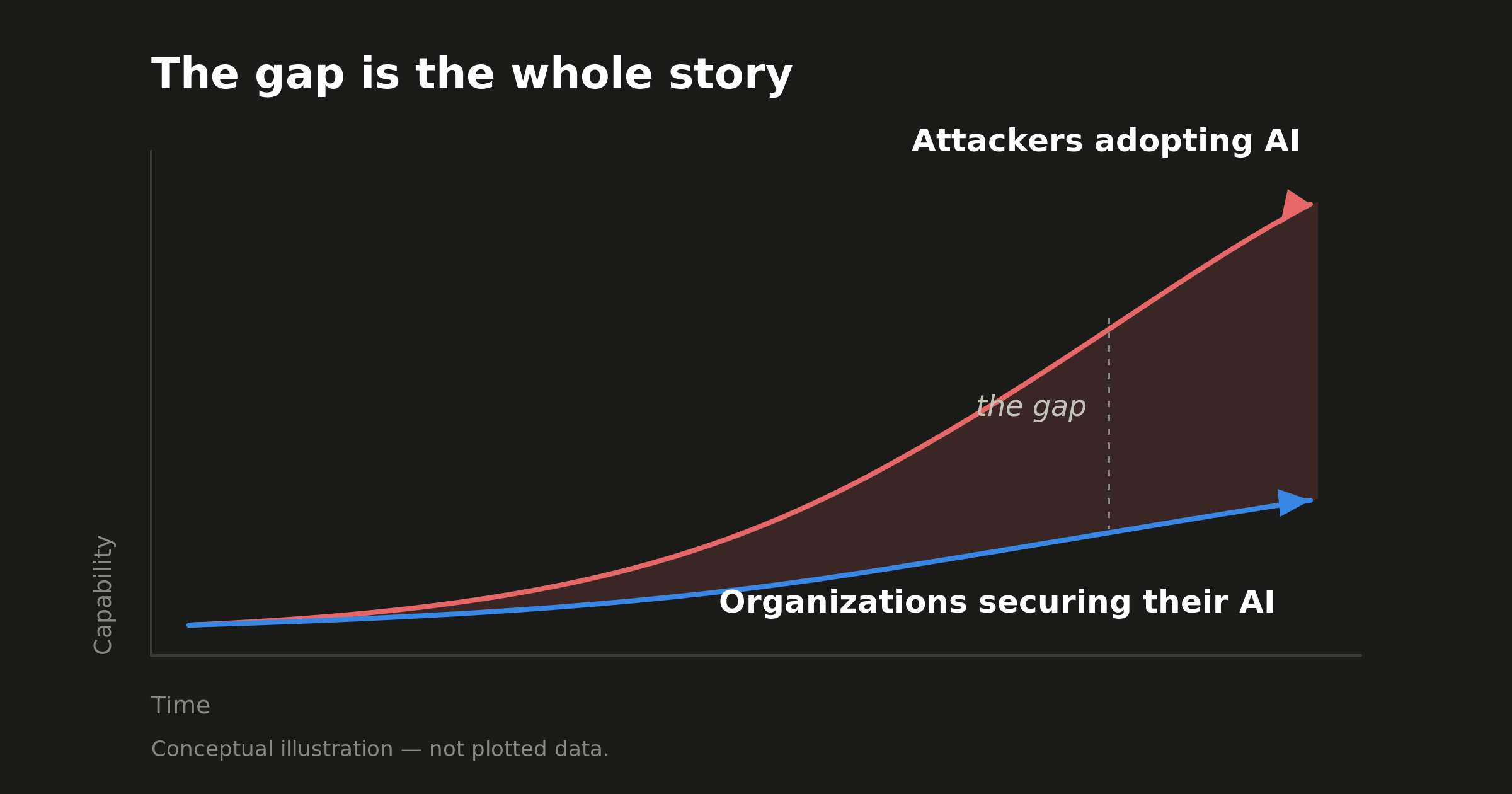

For years, “AI in cybersecurity” was a vendor slide. In 2026, it is the operating condition on both sides of the fight. Attackers use it to compress the kill chain; defenders use it to compress triage. The interesting question is no longer whether AI matters to security, but which side is compounding its advantage faster — and where your own program sits in that race.
The offense side: cheaper, faster, more personal
The clearest change is economic. Tasks that used to require a skilled human — writing a convincing pretext, mapping an unfamiliar network, chaining a vulnerability — now have a partial path to automation. That drops the cost per attack and raises volume.
Fortinet’s 2026 Global Threat Landscape Report frames this as a structural shift: cybercrime no longer behaves as a set of isolated campaigns but as an end-to-end system, with attackers using agentic AI and “shadow agents” to compress the attack lifecycle. The same report ties AI-enabled cybercrime to a 389% year-over-year rise in ransomware victims.
Phishing is where this shows up first, because it is the highest-volume attack class and the most language-dependent. Cyble’s AI Threat Landscape Report 2026 documents named state-linked groups — APT28, APT41, Kimsuky, and APT42 — adopting AI across reconnaissance, phishing, and malware development. That matters more than raw volume statistics: it means AI tooling has moved from commodity spam into targeted operations.
Two caveats worth stating plainly, because this topic attracts inflated numbers:
- Effectiveness gains are real but bounded. Controlled comparisons have found fully AI-automated spear phishing performing roughly on par with campaigns written by human experts — not dramatically better. The gain is scale and cost, not a new ceiling on persuasion.
- Be skeptical of the headline percentages. Figures circulating in 2026 — “82.6% of phishing emails are AI-generated,” “3.4 billion phishing emails daily” — come largely from vendor blogs and statistics-aggregator pages rather than from primary telemetry with a published methodology. Cite the trend; verify the digit before you repeat it.
Deepfake voice fraud and hyper-personalized phishing consistently top practitioner concern lists. In Darktrace’s State of AI Cybersecurity 2026, 87% of security professionals report seeing more AI-driven threats — while few describe themselves as prepared to stop them. That gap between observed threat and felt readiness is the defining posture problem of the year.
The defense side: triage is the real win
Defensive AI has converged on something less glamorous than “autonomous defense” and considerably more useful: alert triage.
The volume problem is arithmetic. SOC teams field thousands of alerts per day, and a large share go unaddressed — not from negligence but from capacity. Any technology that reliably closes low-value alerts buys back analyst attention for the alerts that matter.
The measurable returns are on the response-time axis. IBM’s breach-cost research found organizations with high AI and automation adoption saved roughly $1.9 million per breach and cut the breach lifecycle by about 80 days. That is not a detection-accuracy claim; it is a speed claim, and speed is where AI is genuinely strong.
Microsoft’s writeup on the agentic SOC and Cisco’s Machine Speed, Human Judgment both land on the same architecture: agents handle volume and consistency, humans hold judgment and business context. The useful design principle from practitioner writeups is tiered autonomy — let action impact and model confidence jointly decide how much autonomy a workflow gets. Enriching an alert and closing it as benign pose different risks. Neither is quarantining a laptop and deactivating an executive’s account.
Worth sitting with: In SANS survey data, satisfaction with AI and ML tooling has ranked last among SOC technologies. Adoption is high; maturity is not. Plan for tuning cost, not plug-and-play.
The third front: your AI is now an attack surface
Most coverage misses this. Deploying AI does not only change how you defend — it adds a system that must itself be defended. An LLM with tool access and data access is a new privileged component with an unusual property: untrusted input can influence its control flow.
Prompt injection is the canonical case, cataloged as OWASP LLM01 and as AML.T0051 in MITRE ATLAS. The distinction that matters operationally is direct versus indirect injection: direct arrives in user input, indirect hides in external data your model ingests — a retrieved document, a scraped page, a ticket body, an email. Indirect injection is the harder problem, because the malicious content never passes through a human reviewer.
Three frameworks cover different layers, and none substitutes for the others:
| Framework | Layer | Use it for |
|---|---|---|
| NIST AI RMF | Organizational governance | Risk process, accountability, documentation |
| MITRE ATLAS | Adversary TTPs | Threat modeling, red teaming, detection engineering |
| OWASP Top 10 for LLM Applications | Application and model | Secure development, design and code review |
Practical reading: OWASP during build and review, ATLAS for threat models and detection content, NIST AI RMF for the governance wrapper that an auditor will ask about. The World Economic Forum’s Global Cybersecurity Outlook 2026 names the underlying problem directly: the gap between how fast AI is being deployed and how slowly it is being secured.
What to actually do
Ordered by return on effort, not by novelty:
- Assume pretext quality is no longer a detection signal. Awareness training built on “look for bad grammar” is obsolete. Move to verification behavior — out-of-band confirmation for payment, credential, and access requests — and make it a required workflow step, not advice.
- Add a callback-verification rule for voice. Deepfake voice fraud defeats familiarity. A named policy that any voice request for money or access gets verified on a known-good number costs nothing and closes the vector.
- Deploy AI triage where a wrong answer is cheap. Enrichment, deduplication, and closing high-volume benign alert classes. Keep containment gated behind human approval until you have local false-positive data — not vendor benchmarks.
- Inventory your AI systems as privileged components. Which models touch production data? Which holds the tool or API access? Which ingests untrusted external text? That third question finds your indirect-injection exposure.
- Constrain agent authority at the boundary, not in the prompt: scoped credentials, allowlisted tools, and human approval for irreversible actions. System-prompt instructions are guidance; permissions are enforcement. Do not confuse the two.
- Red team the AI stack specifically. Map ATLAS techniques against your own deployments. A pentest scoped to your network will not find prompt injection in your support-ticket summarizer.
The honest read
AI has not invented a new category of attack. Phishing, social engineering, vulnerability chaining, and fraud all predate it. What has changed is the cost curve — once expensive attacks are now cheap, making marginal targets worthwhile. Small organizations that were previously protected by obscurity are the ones who feel this most.
The defensive advantage is available on the same terms, but it is claimed unevenly. Speed-to-response gains are documented and real. Detection accuracy gains are noisier than the marketing suggests. And the new attack surface you create by deploying AI is the one most programs still aren’t tracking.
Attackers scale their AI faster than most defenders secure theirs. That gap is the whole story of 2026 — and it is a gap you can close deliberately rather than discover during an incident.
Sources
· Fortinet 2026 Global Threat Landscape Report
· Cyble AI Threat Landscape Report 2026
· Darktrace State of AI Cybersecurity 2026
· WEF Global Cybersecurity Outlook 2026
· Microsoft: The Agentic SOC · Cisco: Machine Speed, Human Judgement
· OWASP Top 10 for LLM Applications · NIST AI Risk Management Framework


Leave a Reply